
Category: Science
Man Sets World Record For Longest Stay In Underwater Home To Prove Concept Of Ocean Living
January 7, 2025
Yesterday (Sunday, January 5), Rüdiger Koch set a new world record for the longest continuous stay below the water in an underwater room. The aerospace engineer spent 101 days under the Caribbean Sea just outside Linton Bay, Panama, beating out the previous record of 100 days set by Dr. Joseph Dituri. He passed the 14 weeks and change in a specialized Deepwater Model of the SeaPod, a line of fully aquatic residence homes designed and sold by his company, Ocean Builders.
Speaking to Bored Panda from beneath the waves, the Hemingway-esque industrialist and adventurer, familiarly known as Rudy, joined his co-founder and CEO Grant Romundt to reveal the challenges of spending more than three months underwater—and how doing so will help with an unexpected goal: space travel.
Ocean Builders co-founder and chief engineer Rüdiger Koch has spent over 100 days in an underwater room to prove the feasibility of his company’s Deepwater SeaPods, which will form floating cities

Image credits: Grant Romundt from Ocean Builders

Image credits: Grant Romundt from Ocean Builders
Of course, the immediate purpose of the record attempt was to prove the feasibility of the SeaPod Deepwater Model. Unlike the standard SeaPods, which are designed for depths around 13 feet (four meters), the Deepwater Model is a floating human habitat suitable for the open ocean and capable of handling large swells.
Indeed, stability is one of the SeaPod’s main selling points. Even the current shallow-water models don’t rock in the waves like a boat. “A lot of times you don’t even feel the movement on my SeaPod,” Grant assured us.
Plus, they’re far more spacious and decked out with amenities. The CEO gave us a tour of his own pod, including the kitchen, living room, bathroom, and bedroom, as well as a furnished balcony. Appliances like a large fridge to a temperature-controlled bed run off solar power managed by an internal, liquid-cooled computer. And this is all centered within gorgeous 360-degree views of the bay. Altogether, there are 830 square feet of living space (around 77 square meters).
Ocean Builders already commercially produce shallow-water SeaPods—floating houses with around 830 square feet of living space—in Linton Bay, Panama
View this post on Instagram
Rudy’s underwater room is a bit more cramped, though, at just 300 square feet (about 28 square meters). However, the scientist seemed unfazed by his isolated surroundings. He said he was surprised by how smoothly the stay had gone.
“I was actually expecting some stuff to show up,” he confided in us. “At the beginning we had issues with electricity. I was using too much electricity, a few other things. Nothing serious.”
Part of the record-setter’s high spirits are surely due to his enchanted surroundings. As he spoke to us, fish passed by the windows in the teal water, occasionally stopping to peek in and satisfy their curiosity. Yet, the truth is, Ocean Builders’ chief engineer is far too busy to feel loneliness, claustrophobia, or fear. His vision goes beyond SeaPods.
Ocean Builders moved to Panama after the Thai government destroyed their first prototype off the coast of Phuket in 2019

Image credits: Ocean Builders

Image credits: Grant Romundt from Ocean Builders
View this post on Instagram
After the Thai government destroyed their first prototype off the coast of Phuket, Ocean Builders gained notoriety within the Seasteading movement, drawing the attention of libertarians, anarchists, and other activists looking for a way to escape government authority. However, Grant confided that SeaPods attract a wide range of customers.
“There’s a lot of profiles because we appeal to many different kinds of markets like digital nomads, crypto enthusiasts, the yachties that love being on the water, but maybe want something more like a home now because they’ve been on a boat for so long. And then there’s creative people like musicians and artists that want some place that’s really inspiring to work.”
In Grant’s case, he’d long felt the drive to live on the water. Before founding Ocean Builders, he lived in a floating home in a marina in Toronto. The lifestyle speaks to him on a spiritual level.
SeaPods appeal to a variety of customers, from those looking to escape government authority to artists and musicians looking for an inspiring environment

Image credits: Grant Romundt from Ocean Builders

Image credits: Grant Romundt from Ocean Builders
But for Rudy, Ocean Builders is all about creating the future. To some extent, his SeaPods are about environmentalism. He was once quoted by the Seasteading Institute as saying: “Building on land destroys habitats. Building on the ocean creates habitats. You can’t be an environmentalist if you live on land.”
With the Deepwater Model, the inventor sees himself as one step closer to creating floating cities, which he insists will be even more important in the future due to rising sea levels. Much of his time—while setting the record—has been devoted to bringing about this future. For example, he’s been working on developing an AI that could control mobile robots capable of maintaining and repairing the SeaPods so that the residents don’t need any specialized technical expertise.
“We will be able to provide robots that can actually walk about the house like bipedal robots,” he said. He hopes to have this AI system up in a couple of years.
For Rüdiger Koch, SeaPods are just a stepping stone to space travel—floating cities are necessary to build the futuristic launch loop
View this post on Instagram
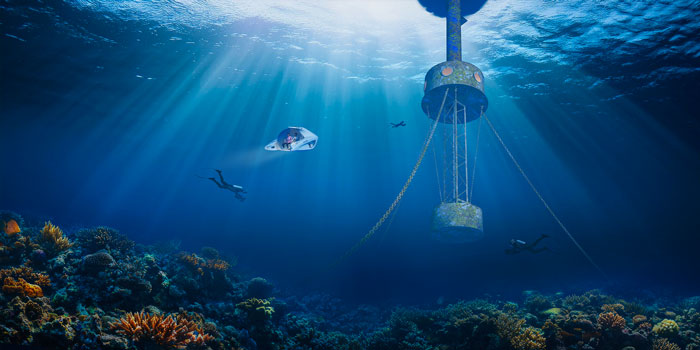
Image credits: Grant Romundt from Ocean Builders (Render Image)
However, even floating cities aren’t Rudy’s end goal. His sights are set on the stars. An aerospace engineer, he only came to co-found Ocean Builders due to his interest in the launch loop, a means of reaching space without rockets. Imagine a giant hula hoop standing upright on the surface of the Earth with the top part in space. Inside the hoop, a maglev train goes around and around at such blistering speeds that, when timed correctly, the centrifugal force can fling a payload into space.
The launch loop is potentially cheaper than rockets since it doesn’t require rocket fuel, and it’s environmentally friendlier for the same reason. Moreover, according to Rudy, it doesn’t require any technology that isn’t already available. It’s merely a question of engineering, which is where he comes in.
Nevertheless, for the immediate future, the visionary remains under the sea. He’s extended his stay to 150 days.
The post Man Sets World Record For Longest Stay In Underwater Home To Prove Concept Of Ocean Living first appeared on Bored Panda.
Terrifying Simulation Reveals What Would Happen To Your Body If Swallowed By A Whale
September 7, 2024
The odds of being sucked into a whale’s mouth are one in a million. By nature, these mammals are very docile, and there has never been a true report of them eating a human.
But if, for some reason, a whale mistook a diver for an animal in their diet and swallowed them whole, the probability of survival would plummet to zero.
A video created by Zack D. Films explores the almost impossible situation, showing the reality of being digested alive.
The animated short was released one month ago but has already amassed more than 40 million views, with users imagining the “completely pitch black” scenario as terrifying.
A human would be killed almost immediately upon entering their digestive tract

Image credits: ullstein bild / Getty
After getting swallowed by a sperm whale, you’d immediately be compressed inside its massive throat and plunged into pitch-black darkness, according to the simulation video. Later, you’d pass through its esophagus.
Once you’ve made it past the narrow pathway, gravity would take you down into a series of one of four stomach chambers, based on the anatomy of a sperm whale. Depending on the species, the number of chambers varies, but either way, you wouldn’t make it out of the first one alive.
Digestive acids can be found in the mammal’s stomach chambers, and the moment a human’s skin comes into contact with it, their entire body will start to break down and their skin will burn.
And by some miracle, if you manage to avoid the acid, the lack of air inside the whale would quickly cause you to suffocate.
Scientifically speaking, a human would die within minutes and be digested like any other prey hunted by the sperm whale.
Anatomy-wise, only a sperm whale’s throat is big enough for a human to squeeze through

Image credits: Zack D. Films
The size of a whale’s throat varies, from the width of a basketball to a human fist, and most whales would not be able to swallow a person.
Under the right circumstances, however, the only species of whale that could swallow a human whole is the sperm whale.
With a regular diet of large prey, such as giant squid and octopus, their throats are relatively big. Although, this isn’t a cause for concern among humans.
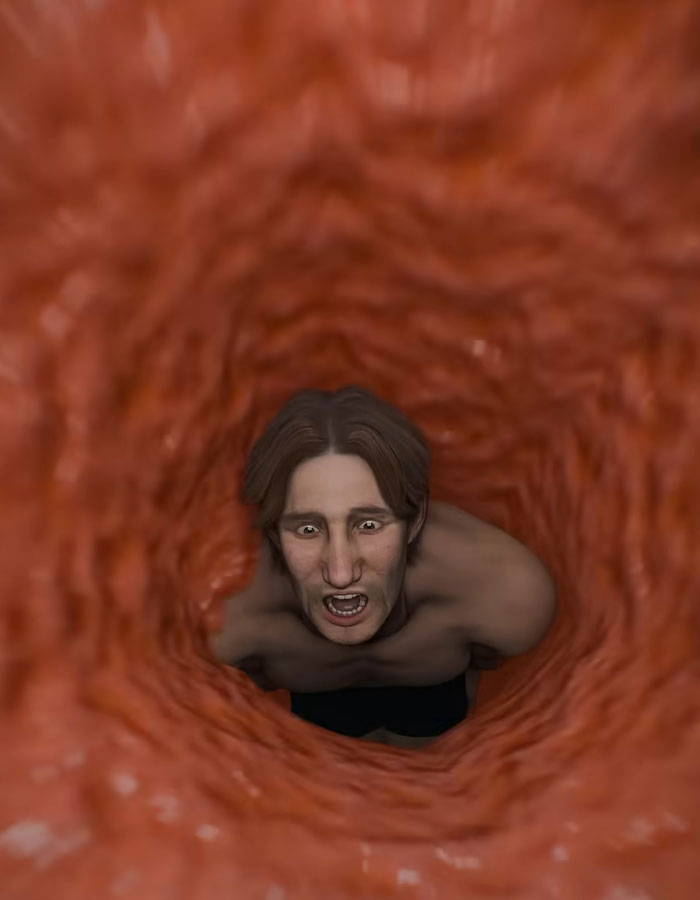
Image credits: Zack D. Films
Sperm whales have one of the widest global distributions of any marine mammal species, spanning from the equator to the edges of the Arctic and Antarctica. And because they only frequent depths of 2,000 feet or below, the likelihood of a human encountering a sperm whale is zero to none.
From the surface, they’re most recognizable by their giant heads. They may not be the biggest mammals on Earth, but they have the largest brains, with an average of 7.8 kg of brain mass in males. For comparison, the mass of a humpback whale’s brain is about 4.6 kg.
A sperm whale’s head can represent a third of their total body length, which can be up to 60 feet long. Their blowholes are also located on a slight diagonal on the left side of their heads.
People started posing hypothetical questions after the widespread story of a 19th-century tale
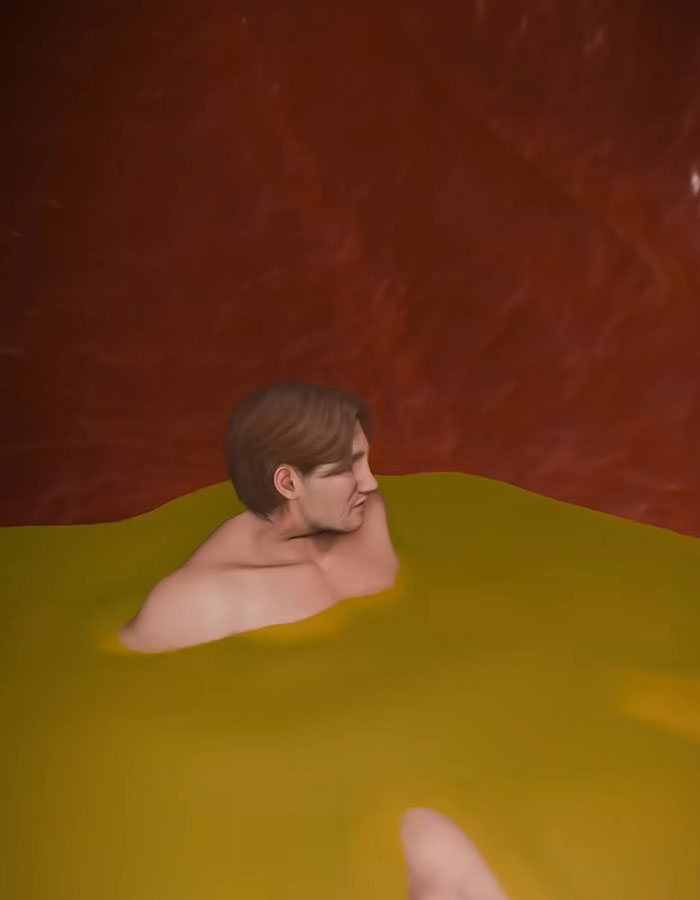
Image credits: Zack D. Films
In 1891, James Bartley of St. Louis, Missouri, came back home with a sensational story to tell.
According to the news reports at the time, Bartley was a young sailor who was swallowed by a sperm whale. The next day, the same whale was killed, and his belly was cut open. Bartley popped out, blind and injured by corrosive stomach acid but miraculously alive.
This alleged incident unfolded in February 1891 about two hundred miles east of the Falkland Islands in the South Atlantic Ocean.
A whaling ship named Star of the East was on the lookout when a sperm whale was spotted about 3 miles away. The ship lowered two small boats, which later began to race with the whale.
When one of the crew leaned over to drive a weapon into the whale, it started thrashing, which sent the passengers on the smaller boats into the water. As the crew later looked to rescue the sailors, Bartley was missing.
After killing the whale and discovering that something was moving inside the mammal’s stomach, they cut the organ open, only to find Bartley, who had been inside for 15 hours. His skin was bleached a deathly white from its digestive juices, and the sailor was blind and had lost most of his hair.
But the young sailor had survived — something that should have been physically impossible.
Scientifically and historically, there isn’t an ounce of truth behind the tale
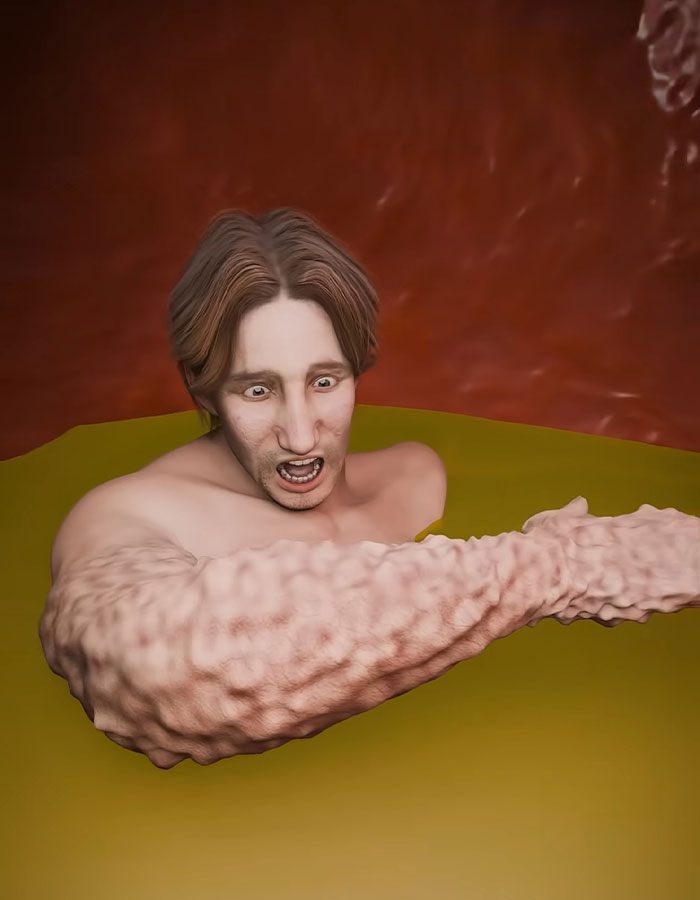
Image credits: Zack D. Films
While Bartley’s story was widely accepted and talked about, it may just be a made-up myth. According to Amusing Planet, Historian Edward B. Davis said that while there was a British ship by the name of Star of the East, it wasn’t near the Falklands at the time of the incident, and there was certainly no James Bartley on its crew.
With the lack of air inside a whale’s body and its corrosive gastric acid, there is no way James Bartley, now referred to as “Modern Day Jonah,” could have made it out alive.
The Eden Killer Whale Museum in New South Wales has added, as accounted by Bartley’s story, that a sperm whale inhales deeply before diving, storing oxygen in its body. This raised the question: “Could it be that James Bartley survived through the storing up of oxygen?”
The answer is no. But if the museum believed it a possibility for 100 years, then it’s no surprise the media did, too.
Social media users either mentioned the old tale or joked that this information was very helpful

Image credits: Zack D. Films
The Internet community was quick to comment on the absurdity of the scenario.
One comment said, “I’m glad people are using technology to answer the important questions,” while another joked, “Going on past experiences, it’s nothing like this.”
Others mentioned James Bartley by his biblical name.
“FYI Jonah was swallowed by a fish. We don’t know the species. And for all we know, God could have created it specifically to be able to hold someone in its belly without harming it,” a user said.
Users online joked about the unlikeliness of this situation












The post Terrifying Simulation Reveals What Would Happen To Your Body If Swallowed By A Whale first appeared on Bored Panda.
Linguistics Study Reveals Link Between Loudness Of A Language And Region Temperature
December 7, 2023
We’ve all heard those stereotypes portraying people who speak Latin languages, whether that be Spanish, French, or Italian, as sounding more “passionate” or even “loud”.
As it turns out, the stereotype may stem from some truth, as a new study published on Thursday (December 5) suggested that temperatures influence the way we talk.
Dr. Søren Wichmann, a linguist at Kiel University in Germany, together with colleagues from China, demonstrated in the study that was published in the online journal PNAS Nexus that average ambient temperatures influenced the loudness of certain speech sounds.
Languages in warmer regions are louder than those in colder regions, a linguistics study found

Image credits: Tianheng Wang, Søren Wichmann
Søren explained: “Generally speaking, languages in warmer regions are louder than those in colder regions.”
To summarize the study, we are surrounded by air when we speak and listen; therefore, spoken words are transmitted through the air as sound waves, as per Phys Org. As a result, the physical properties of air influence how easy it is to produce and hear speech.
Søren explained: “On the one hand, the dryness of cold air poses a challenge to the production of voiced sounds, which require vibration of the vocal cords. On the other hand, warm air tends to limit unvoiced sounds by absorbing their high-frequency energy.”

Image credits: Qian Gu
These factors could reportedly favor a higher volume of certain speech sounds in warmer climates, known as sonority in scientific terms.
The Danish linguist and his colleagues reportedly used the Automated Similarity Judgment Program (ASJP) database to test whether these factors really had an effect on the development of languages.
We are surrounded by air when we speak and listen. Therefore, spoken words are transmitted through the air as sound waves

Image credits: Łukasz Maźnica
At the moment, the database is reported to contain the basic vocabulary of 5,293 languages and is constantly being expanded with the support of the ROOTS Cluster of Excellence, a German research institution in Kiel.
Subsequently, Søren and his team discovered that languages that occur around the Equator in particular have a high average sonority, whereas languages in Oceania and Africa have the highest corresponding index.
On the other hand, the world record for low sonority reportedly belongs to the Salish languages on the northwest coast of North America.

Image credits: Priscilla Du Preez 🇨🇦
Nevertheless, some exceptions have been found in this trend. For instance, some languages in Central America and on the Southeast Asian mainland have a rather low mean sonority, even though they are spoken in very warm regions.
Søren stated: “Overall, however, we were able to establish a clear relationship between the mean sonority of language families and the mean annual temperature.”
The physical properties of air influence how easy it is to produce and hear speech

Image credits: MART PRODUCTION
As a result, the exceptions indicate that the effects of temperature on sonority develop only slowly and only shape the sounds of a language over centuries or even millennia.
Scientists are reportedly in the midst of discussing the extent to which the environment shapes languages.

Image credits: Gabriel Foureaux
The linguistics expert revealed: “For a long time, research assumed that linguistic structures are self-contained and are not influenced in any way by the social or natural environment. More recent studies, including ours, are beginning to question this.”
Søren further informed that “If languages adapt to their environment in a slow process lasting thousands of years, then they carry some clues about the environment of their predecessor languages.”